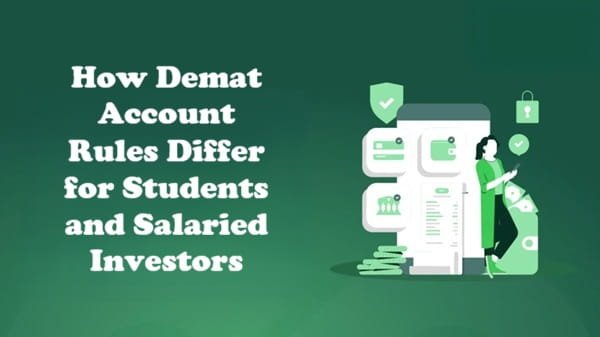
Opening a Demat account is an important step for anyone who wants to invest in shares, exchange-traded funds (ETFs), bonds, and other eligible securities in India. However, students and salaried investors may have different requirements when opening and managing these accounts. While both groups generally follow the same securities-market framework, their age, income sources, documentation, and financial circumstances can influence the account-opening process.
Understanding these differences helps investors select the appropriate account structure, prepare the necessary documents, and avoid common mistakes. It is also important to distinguish between regulatory requirements and individual brokers’ policies, as account-opening procedures and service conditions can vary.
What Is a Demat Account?
A Demat account holds securities electronically instead of requiring physical certificates. In India, these accounts are maintained through depository participants connected to the country’s securities depositories.
Investors commonly use Demat accounts to hold listed shares, ETFs, and other eligible securities. A trading account may also be needed to buy and sell securities on stock exchanges.
Students and salaried individuals can both open Demat accounts if they meet the applicable eligibility and verification requirements. However, the process can differ depending on whether the investor is a minor or an adult and whether they have an independent income source.
1. Age and Eligibility Requirements
Age is one of the most important factors affecting Demat account eligibility.
Students who are minors: Individuals below 18 years of age can generally hold a Demat account through the prescribed process involving a parent or legal guardian. The guardian handles the required account-opening formalities on the minor’s behalf, subject to applicable rules.
A minor’s account has restrictions, particularly regarding independent trading and the operation of a trading account. The permitted transactions and services depend on the applicable regulations and intermediary procedures.
Students who are adults: Students aged 18 or older can generally open and operate their own Demat accounts after completing the required verification process. They do not need to be employed simply to hold a Demat account.
Salaried investors: Adults who meet the applicable eligibility and KYC requirements can generally open their own accounts regardless of whether they work in the private sector, public sector, or another eligible employment arrangement.
Therefore, being a student does not automatically prevent someone from investing. Age and account structure are more important than student status alone.
2. Income Proof and Financial Documentation
Students and salaried investors may differ in the supporting documents they have available.
Students may not have salary slips, employment letters, or regular income statements. However, a salary certificate is not generally a universal requirement for opening a basic Demat account.
Applicants typically need to complete the prescribed identity and KYC requirements, including applicable PAN and other verification details. Additional documents may be requested depending on the account type, service, or intermediary’s procedures.
Salaried investors may have access to salary slips, employment records, bank statements, and income-tax documents. These can be useful when applying for services that require financial information.
Importantly, proof of employment and proof of identity serve different purposes. A salaried investor should not assume that employment documents replace the required KYC process, and a student should not assume that lacking salary slips makes them ineligible for a Demat account.
3. Bank Account Requirements
Both students and salaried investors generally need appropriate banking arrangements to fund investments and receive eligible proceeds.
An adult student may use an eligible bank account in their own name, subject to the broker’s requirements and applicable rules. Students who hold minor bank accounts should confirm the permitted operating arrangements and whether those accounts can be linked to the intended investment account.
Salaried investors often use their regular salary accounts for investment-related transfers.
In either case, investors should ensure that their bank details are accurate and that the account meets the intermediary’s requirements. Incorrect details can delay verification, withdrawals, or other account-related processes.
4. Trading Permissions and Account Operation
A significant difference exists between minor and adult investors.
A minor’s Demat account is operated through the prescribed guardian arrangement, and the minor generally cannot independently operate a regular trading account in the same way as an adult. Permitted transactions are subject to applicable rules and restrictions.
Once an investor turns 18, the account generally needs to be transitioned to an adult account arrangement through the relevant procedures. The investor may need to submit fresh documentation, complete verification, and execute required forms.
Adult students and salaried investors can generally operate their accounts independently after satisfying the applicable requirements.
Employment status itself does not ordinarily determine whether an adult can place an eligible investment order.
5. Charges and Account Maintenance
Students often have limited budgets and may prefer accounts with low maintenance costs. Salaried investors may be more willing to pay for additional features if those services suit their investment activity.
However, brokers do not necessarily charge students and salaried investors different fees simply because they belong to different categories.
Account-opening charges, annual maintenance charges, brokerage, Demat transaction fees, and other costs depend on the provider’s published tariff schedule and the chosen account plan.
Some brokers may offer promotional pricing or special account categories, but investors should verify the terms rather than assume that student accounts are automatically free.
Before opening an account, compare the total expected cost based on how frequently you plan to invest or trade.
6. Income Tax and Investment Records
Students and salaried investors are subject to applicable tax rules based on their income, transactions, and individual circumstances—not merely their occupation.
For example, gains from selling investments may have tax consequences depending on the type of security, holding period, transaction details, and current tax provisions.
A salaried investor may also have employment income, while a student may have little or no independent income. However, this difference does not automatically determine the tax treatment of investment gains.
Investors should maintain transaction statements, contract notes where applicable, and other relevant records. If investments are funded by a parent or another family member, the source of funds and any applicable tax implications should be considered separately.
Because tax laws can change, investors should verify current requirements or consult a qualified tax professional when necessary.
7. Choosing the Right Demat Account
Students should prioritise straightforward account management, reasonable charges, security, and access to basic investment services. They should also avoid borrowing money or taking excessive trading risks simply to participate in the stock market.
Salaried investors may place greater emphasis on portfolio reporting, service quality, transaction costs, and features suited to their financial goals.
Both groups should verify the provider’s regulatory standing, read the fee schedule, understand the grievance-redressal process, and protect their login credentials.
The right account depends on the investor’s age, needs, financial circumstances, and intended use—not simply whether they are studying or working.
Final Thoughts
Demat account rules do not create a completely separate framework for students and salaried investors. Most differences arise from age, account operation, available documentation, financial circumstances, and the specific services being requested.
Minor students generally require a guardian-operated account arrangement, while adult students can usually open their own accounts without having a salary. Salaried investors may have additional income documents available, but employment does not remove the need to meet standard KYC requirements.
Before opening a Demat account, confirm your eligibility, prepare the required documents, compare charges, and understand the rules that apply to your account category. By focusing on these practical requirements, both students and salaried investors can begin investing with greater confidence and fewer administrative complications.